
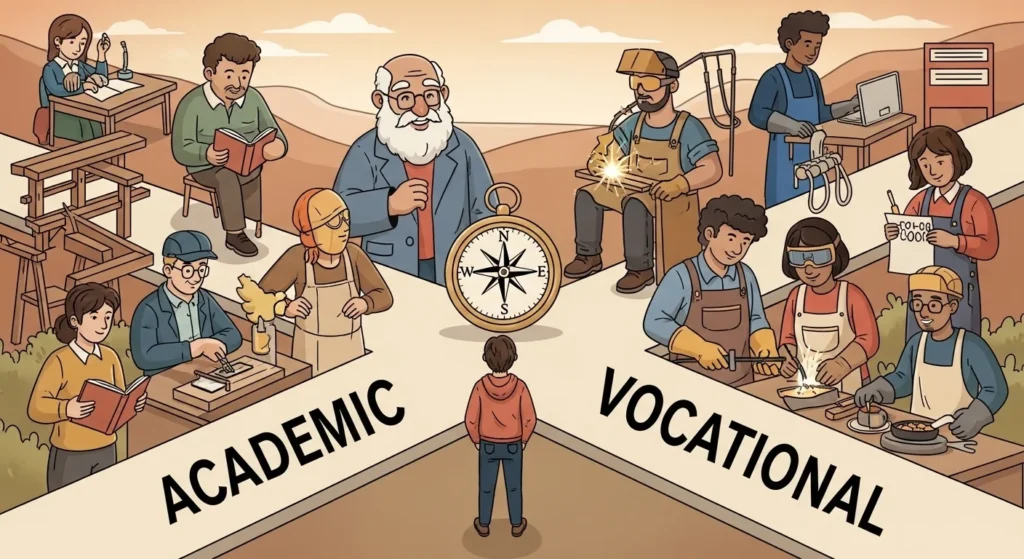

What Does “Vocational” Mean?
The word vocational is an adjective that relates to:
Work, careers, or professions
Training for a specific trade or occupation
Simple definition:
Vocational = related to a job, trade, or skill-based career training.
For example:
Vocational school – A school focused on teaching skills for a particular career.
Vocational training – Practical education to prepare for a profession, like plumbing, nursing, or IT support.
Origin of the Word
Derived from the Latin word “vocatio”, meaning “call” or “summons”.
Originally, it meant a calling in life, often connected to one’s career or profession.
Over time, it became associated with practical education and skill-building.

How People Use “Vocational” in Real Life
1. Education
Vocational is often mentioned in education:
Vocational schools / trade schools: Institutions that teach hands-on skills for careers like electricians, chefs, or carpenters.
Vocational courses: Classes that focus on practical skills rather than academic theory.
Example:
“She enrolled in a vocational course in graphic design to start working immediately after finishing school.”
2. Career and Employment
Vocational can describe jobs and professional paths:
Vocational jobs – Positions requiring specific skills learned through training, such as mechanics, nurses, or welders.
Vocational guidance – Help provided by counselors to choose a career path suited to one’s skills.
Example:
“He got vocational training in carpentry, which helped him get a steady job.”
3. Modern Online Usage
In 2025, you might see the word vocational in discussions online, especially related to:
Career advice blogs
Educational websites
Social media posts about skill-building
Example:
“If you’re not planning to go to university, consider vocational education to gain employable skills quickly.”
Real-Life Examples
Here are some realistic examples of how “vocational” is used:
School Context:
“My high school offers vocational programs in IT, healthcare, and automotive repair.”
Career Context:
“She completed vocational training in culinary arts and now works as a pastry chef.”
Online Discussion:
“Vocational courses are perfect for people who want hands-on experience rather than academic theory.”
Guidance Advice:
“Counselors provide vocational guidance to help students find careers that match their skills.”

Common Mistakes & Misunderstandings
Vocational ≠ Academic
Some think vocational training is “less important” than traditional schooling. In reality, it prepares people for specific, in-demand jobs.Vocational ≠ Temporary or Low-Skilled Work
Vocational jobs can be highly skilled, specialized, and well-paying. Examples: electricians, software technicians, healthcare professionals.Vocational ≠ Hobby
Practicing a hobby doesn’t make it vocational. Vocational skills are career-oriented and professionally applicable.
Related Terms & Concepts
If you’re exploring the meaning of vocational, these related terms are useful:
Trade school – Another name for a vocational school.
Technical education – Focused on practical, career-oriented skills.
Apprenticeship – On-the-job training for a specific trade.
Professional training – Vocational education for a specific occupation.
Skill-based education – Learning by doing rather than theory-focused study.