

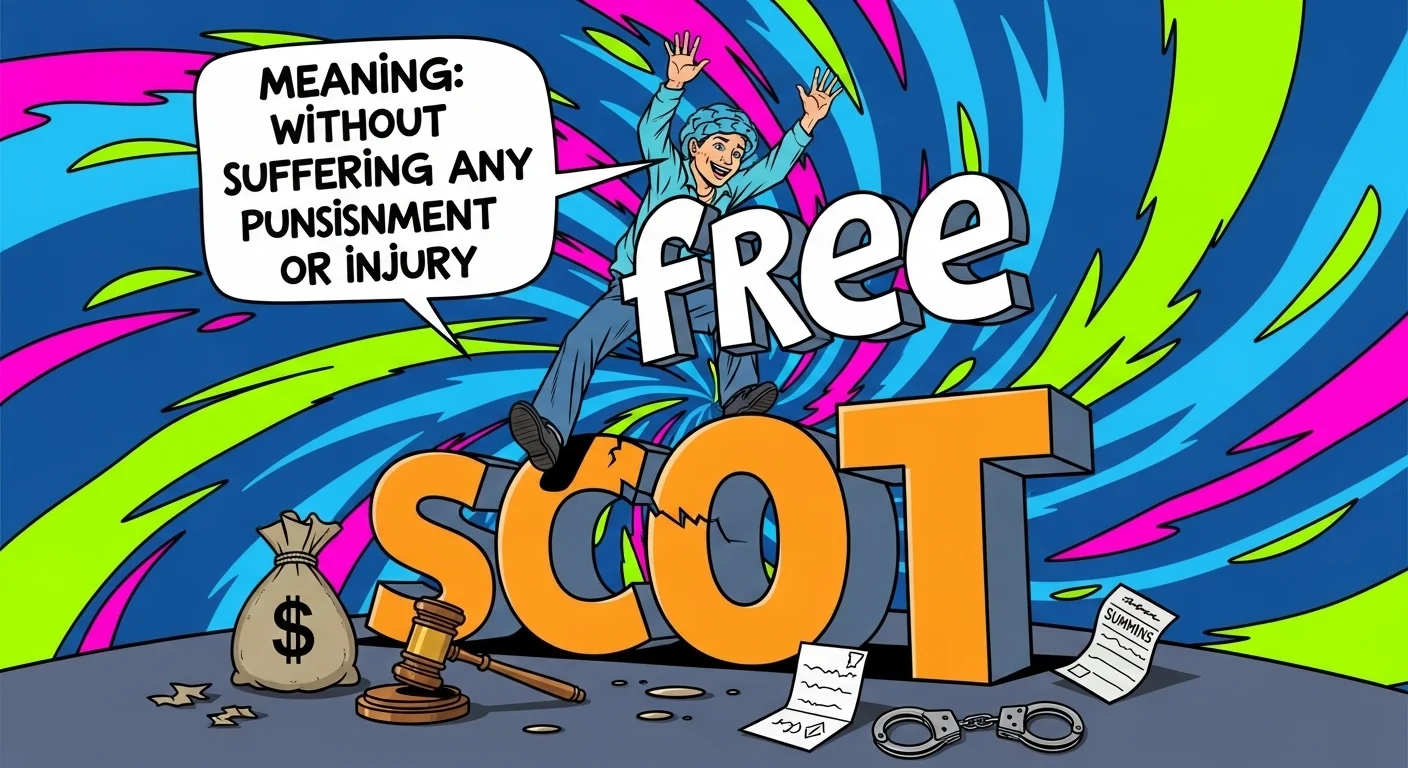
What Does “Scot-Free” Mean in Chat or Text?
The scot-free meaning is simple:
Scot-free means escaping punishment, responsibility, or consequences for something wrong or unfair.
In both formal and casual language, the phrase describes a situation where someone should face consequences but ends up avoiding them completely.
Simple Definition
Scot-free = avoiding punishment or blame.
Example
“Everyone else got detention, but Jake got away scot-free.”
This means Jake did not get punished even though others did.
Scot-Free Meaning in Online Conversations
In texting, social media, or online discussions, people use the phrase when someone:
Avoids getting in trouble
Escapes consequences
Gets lucky after doing something wrong
Example in chat:
Friend 1:
“Did the teacher find out who broke the window?”
Friend 2:
“Nope. The guy who did it got away scot-free.”
The meaning here is clear: the person responsible did not get punished.
The Origin of the Phrase
Many people think “scot” refers to a Scottish person, but the real origin is different.
The word “scot” comes from an old English term meaning a tax or payment. In medieval times, people had to pay a local tax called “scot.”
If someone was “scot-free,” it meant they did not have to pay the tax.
Over time, the meaning evolved to describe escaping any kind of penalty or responsibility.

How People Use “Scot-Free” in Real Conversations
Even though the phrase is old, people still use “scot-free” frequently in modern speech, news, and online discussions.
You might see it used in:
Text messages
Social media posts
News headlines
Online forums
Workplace conversations
The phrase usually appears when someone feels a situation is unfair or surprising.
Common Situations Where People Use Scot-Free
1. Someone Escapes Punishment
Example:
“He cheated on the test and still got away scot-free.”
Meaning: He avoided punishment.
2. Workplace Situations
Example:
“Everyone else got blamed, but the manager walked away scot-free.”
Meaning: The manager avoided responsibility.
3. Legal or News Situations
Example:
“The company paid a small fine and got off scot-free.”
Meaning: The punishment was minimal or nonexistent.
4. Friend Group Drama
Example:
“She started the argument but somehow got away scot-free.”
Meaning: She caused the problem but didn’t face consequences.
When It Sounds Natural
The phrase works well in:
Storytelling
Complaints about fairness
Casual conversation
Online discussions
However, it is less common in very informal texting slang, where people might instead say things like “he got away with it.”

Real-Life Examples of “Scot-Free” in Text Messages
Seeing examples helps you understand how the phrase actually appears in conversations.
Example 1: School Situation
Student 1:
“Who got caught using their phone during the test?”
Student 2:
“Three people got detention, but Alex got away scot-free.”
Explanation:
Alex avoided punishment while others didn’t.
Example 2: Workplace Chat
Coworker 1:
“The project failed. Who got blamed?”
Coworker 2:
“Everyone except the guy who made the mistake. He got off scot-free.”
Explanation:
The person responsible avoided consequences.
Example 3: Group Chat
Friend 1:
“You broke the remote, didn’t you?”
Friend 2:
“No proof. I’m getting away scot-free.”
Explanation:
The person jokingly admits they avoided blame.
Example 4: Family Conversation
Sibling:
“You ate the last slice of pizza.”
Reply:
“Maybe. But I got away scot-free.”
Explanation:
The speaker avoided getting in trouble.
Example 5: Online Comment
Commenter:
“Big companies always get away scot-free.”
Explanation:
The writer believes companies avoid consequences for wrongdoing.
Common Mistakes & Misunderstandings
Even though scot-free meaning is simple, people often misunderstand the phrase.
Here are some common mistakes.
1. Thinking It Refers to Scotland
One of the biggest misunderstandings is believing the phrase refers to Scottish people.
It doesn’t.
The word “scot” originally meant a tax or payment, not nationality.
2. Spelling It Incorrectly
Many people write:
Scott free
Scotfree
Scotch free
The correct spelling is:
Scot-free
3. Using It for Neutral Situations
The phrase works best when someone avoids consequences for something negative.
Incorrect example:
“He finished his homework scot-free.”
This sounds strange because there was no punishment involved.
Correct example:
“He didn’t do his homework but somehow got away scot-free.”
4. Assuming It Means Completely Innocent
“Scot-free” doesn’t necessarily mean the person did nothing wrong.
Instead, it usually means they avoided consequences even if they were responsible.
Related Slangs & Expressions
If you’re learning idioms like scot-free, here are a few similar phrases you might see in online conversations.
1. “Get Away With It”
Meaning: Avoid punishment for something wrong.
Example:
“He lied but got away with it.”
2. “Off the Hook”
Meaning: Escaping responsibility.
Example:
“The meeting got canceled, so I’m off the hook.”
3. “Dodge the Bullet”
Meaning: Avoid a bad situation.
Example:
“I almost signed that contract. Glad I dodged the bullet.”
4. “Slip Through the Cracks”
Meaning: Avoid being noticed or punished.
Example:
“The mistake slipped through the cracks.”
5. “No Consequences”
Meaning: Someone faced zero punishment.
Example:
“He broke the rules and faced no consequences.”