

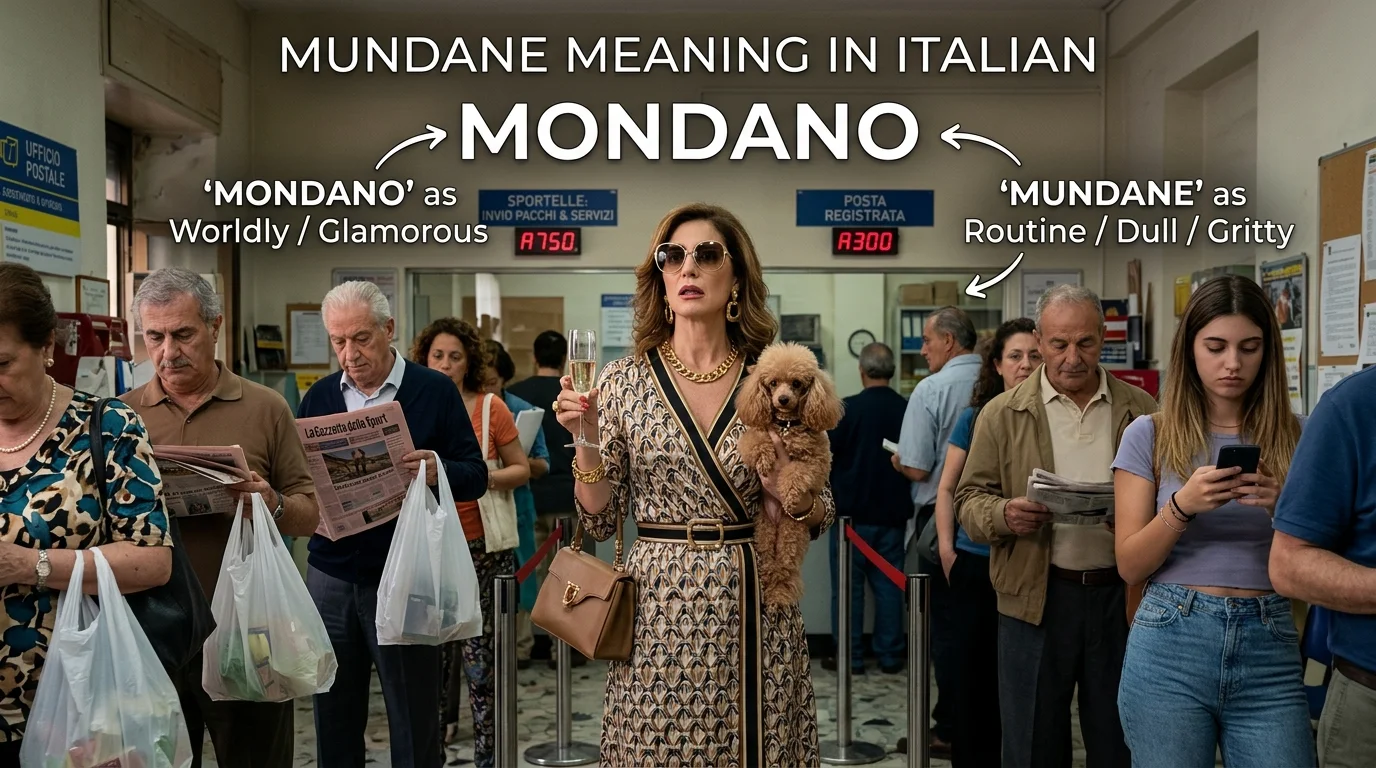
What Does “Mundane” Mean in Italian?
In English, mundane means ordinary, everyday, routine, or lacking excitement.
The most common Italian translations include:
- Banale (banal, ordinary)
- Ordinario (ordinary)
- Quotidiano (everyday)
- Comune (common)
- Terrestre (worldly, depending on context)
Simple Definition
Mundane = something ordinary, routine, or not particularly interesting.
Italian Translation Examples
| English | Italian |
|---|---|
| Mundane task | Compito ordinario |
| Mundane routine | Routine quotidiana |
| Mundane life | Vita ordinaria |
| Mundane conversation | Conversazione banale |
Different Meanings of Mundane
The meaning of mundane can vary slightly depending on the context.
1. Ordinary or Everyday
This is the most common meaning.
Example:
“The movie focuses on mundane daily activities.”
Italian:
“Il film si concentra sulle attività quotidiane.”
2. Boring or Unexciting
Sometimes mundane suggests something lacks excitement.
Example:
“His job became mundane after several years.”
Italian:
“Il suo lavoro è diventato banale dopo diversi anni.”
3. Worldly (Formal Meaning)
In formal or philosophical contexts, mundane can refer to earthly matters rather than spiritual ones.
Example:
“Mundane concerns distracted him from meditation.”
Italian:
“Le preoccupazioni terrene lo distraevano dalla meditazione.”
Origin of the Word Mundane
The English word mundane comes from the Latin word mundus, meaning “world.”
Because of this origin, the word originally referred to things related to the world or earthly life.
Over time, it evolved to mean:
- Everyday
- Ordinary
- Common
- Routine
Italian and English share some Latin roots, which is why certain meanings are similar across both languages.
How People Use Mundane in Real Conversations
Although mundane is not slang, it appears frequently in:
- Daily conversations
- Books and novels
- Movies and TV shows
- Self-improvement content
- Workplace discussions
- Travel blogs
Common English Examples
People often say:
- “My daily routine feels mundane.”
- “The task was mundane but necessary.”
- “She wanted to escape her mundane life.”
- “Most of the work is fairly mundane.”
Similar Italian Expressions
Italian speakers might say:
- “È una routine quotidiana.”
- “La vita è diventata ordinaria.”
- “È un compito banale.”
- “È una situazione comune.”
Real-Life Examples of Mundane
Example 1
English:
“My job involves many mundane tasks.”
Italian:
“Il mio lavoro comporta molti compiti ordinari.”
Meaning:
The tasks are routine and not very exciting.
Example 2
English:
“She was tired of her mundane schedule.”
Italian:
“Era stanca della sua routine quotidiana.”
Meaning:
She wanted more excitement in her life.
Example 3
English:
“The conversation started with mundane topics.”
Italian:
“La conversazione è iniziata con argomenti comuni.”
Meaning:
The discussion focused on everyday subjects.
Example 4
English:
“Even mundane moments can become special.”
Italian:
“Anche i momenti ordinari possono diventare speciali.”
Meaning:
Ordinary experiences can still be meaningful.
Example 5
English:
“He wanted a break from mundane responsibilities.”
Italian:
“Voleva una pausa dalle responsabilità quotidiane.”
Meaning:
He needed a break from everyday obligations.

Common Mistakes & Misunderstandings
Many learners misunderstand the word mundane.
1. Thinking Mundane Means Bad
Mundane does not automatically mean negative.
Something can be ordinary without being unpleasant.
2. Confusing Mundane with Boring
Although mundane can imply boredom, it primarily means ordinary or routine.
3. Using Only One Italian Translation
Depending on context, different Italian words may fit better:
- Banale
- Ordinario
- Quotidiano
- Comune
- Terreno
4. Assuming Mundane Means Useless
Routine tasks may seem mundane, but they can still be important.
5. Ignoring Context
A mundane activity in one situation may feel exciting in another.
Synonyms of Mundane
Here are common English synonyms:
- Ordinary
- Everyday
- Routine
- Common
- Typical
- Unremarkable
- Conventional
- Familiar
- Average
- Predictable
Italian Synonyms
- Ordinario
- Quotidiano
- Comune
- Normale
- Banale
Antonyms of Mundane
The opposite of mundane includes:
- Exciting
- Extraordinary
- Remarkable
- Fascinating
- Unusual
- Exceptional
- Unique
Example
Mundane: A typical day at the office.
Extraordinary: A once-in-a-lifetime adventure.
Related Words and Expressions
If you’re learning the meaning of mundane in Italian, you may also encounter:
1. Ordinario
Ordinary or regular.
2. Quotidiano
Daily or everyday.
3. Banale
Banal or unoriginal.
4. Comune
Common or usual.
5. Routine
A regular pattern of activities.
6. Straordinario
Extraordinary (opposite of mundane).
7. Eccezionale
Exceptional.
These words are useful when expanding your Italian vocabulary.

Why Understanding Mundane Matters
Learning the meaning of mundane can help you:
- Improve English and Italian vocabulary
- Translate accurately
- Understand books and media
- Express everyday experiences clearly
- Communicate naturally in conversations
Because the word appears frequently in literature, education, and daily speech, it is a valuable addition to your language skills.