
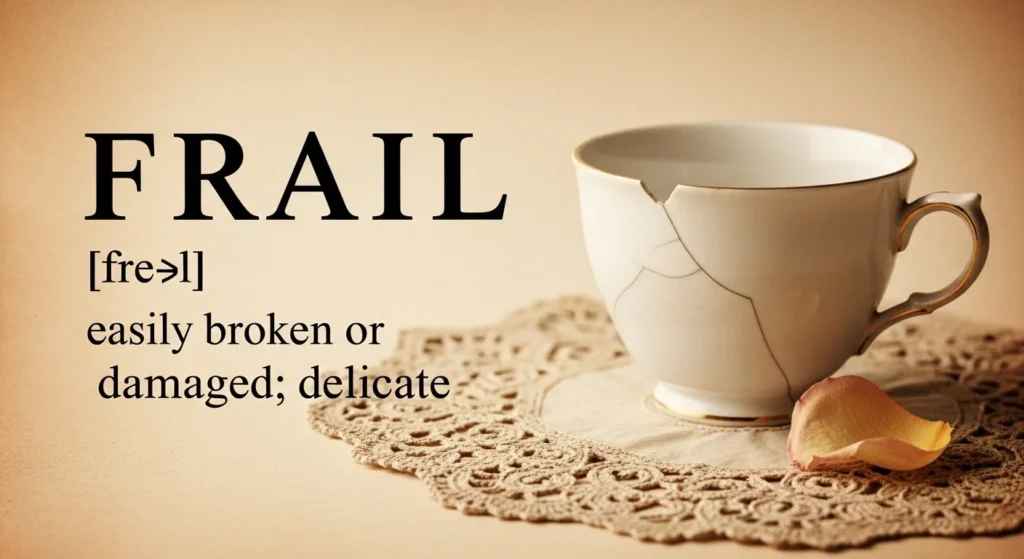

What Does “Frail” Mean in Chat or Text?
Definition:
Frail means physically weak, delicate, or not strong, and sometimes emotionally sensitive or fragile.
Simple explanation
If someone or something is frail, it usually means:
Not physically strong
Easily hurt, broken, or damaged
Thin or delicate
Vulnerable or fragile
Different meanings based on context
1. Physical health meaning (most common)
Used to describe a person who is:
Weak from age or illness
Thin and lacking strength
Easily tired or injured
Example:
“The frail old man needed help walking.”
2. Object meaning
Used for things that are:
Weakly built
Easily broken
Not sturdy
Example:
“The chair looked frail and unstable.”
3. Emotional or psychological meaning
Sometimes used to describe:
Emotional sensitivity
Vulnerability
Fragile confidence
Example:
“After the loss, she felt emotionally frail.”
4. Figurative or descriptive writing
Writers use frail to describe:
Weak systems
Unstable plans
Temporary safety
Example:
“The peace agreement was frail.”
Here it means easily broken or uncertain.
Origin of the word
The word comes from Old French frele, meaning weak or fragile. It has been used in English for centuries to describe lack of strength, especially in health or structure.

How People Use “Frail” in Real Conversations
The frail meaning in everyday English appears in many contexts.
1. Talking about health or elderly people
This is the most common use.
Example:
“My grandfather is getting frail now.”
Meaning:
He’s becoming physically weaker due to age.
This usage is usually neutral or sympathetic, not insulting.
2. Medical or caregiving discussions
Doctors and caregivers often use the word professionally.
Example:
“The patient is frail and needs assistance.”
Meaning:
The person has low physical strength or resilience.
In healthcare, frailty refers to reduced physical capacity and higher risk of illness or injury.
3. Describing objects
Example:
“That ladder looks frail.”
Meaning:
It may not support weight safely.
4. Casual or online conversations
Sometimes used humorously or dramatically.
Example:
“After that workout, I feel frail.”
Meaning:
Feeling weak or tired (not literally fragile).
5. Literature or storytelling
Writers use frail for emotional tone.
Example:
“He held the frail letter carefully.”
Meaning:
The paper was delicate or old.
When it’s appropriate vs awkward
Appropriate:
Talking about health respectfully
Describing delicate objects
Emotional or poetic writing
Medical or caregiving contexts
Potentially awkward:
Calling someone frail directly (can sound insensitive)
Using it jokingly about serious illness
Overusing it in casual situations
Better:
“She’s feeling weak” (gentler)
Instead of: “She’s frail” (can sound harsh)
Real-Life Examples of “Frail” in Sentences
Here are practical examples with explanations.
Example 1
“The frail woman slowly crossed the street.”
Meaning: She was physically weak or delicate.
Example 2
“Be careful with that frail box.”
Meaning: The box is weak and may break.
Example 3
“His voice sounded frail after being sick.”
Meaning: His voice lacked strength.
Example 4
“The frail bridge couldn’t handle heavy trucks.”
Meaning: The structure isn’t strong enough.
Example 5 (casual modern use)
“I skipped breakfast and now I feel frail.”
Meaning: Feeling weak or low-energy (not serious).
These examples show that frail always relates to lack of strength or durability, whether physical, structural, or emotional.

Common Mistakes & Misunderstandings
1. Thinking frail only applies to old people
While often used for elderly individuals, it can describe:
Sick adults
Injured people
Thin or weak animals
Objects or systems
It’s broader than age.
2. Using it as an insult
Calling someone frail can sound:
Judgmental
Insensitive
Negative
Especially if said directly.
Better alternatives:
“She’s recovering”
“He’s feeling weak lately”
3. Confusing frail with skinny
Not the same.
Skinny: Thin body size
Frail: Weak or delicate
Someone can be skinny but strong, or frail but not thin.
4. Mixing it with fragile
They’re similar but slightly different:
Fragile: Easily broken (objects or emotions)
Frail: Weak or lacking strength
A glass is fragile.
An elderly person may be frail.
Related Words & Synonyms
If you’re learning what does frail mean, these similar words help:
1. Weak
Basic everyday synonym.
Example: “He feels weak.”
2. Fragile
Easily broken or sensitive.
Example: “The vase is fragile.”
3. Delicate
Light, sensitive, or needing careful handling.
Example: “She has delicate health.”
4. Feeble
Very weak (more formal, sometimes negative).
Example: “He spoke in a feeble voice.”
5. Vulnerable
Easily harmed physically or emotionally.
Example: “Children are vulnerable in extreme weather.”