
What Does “Cycle” Mean?
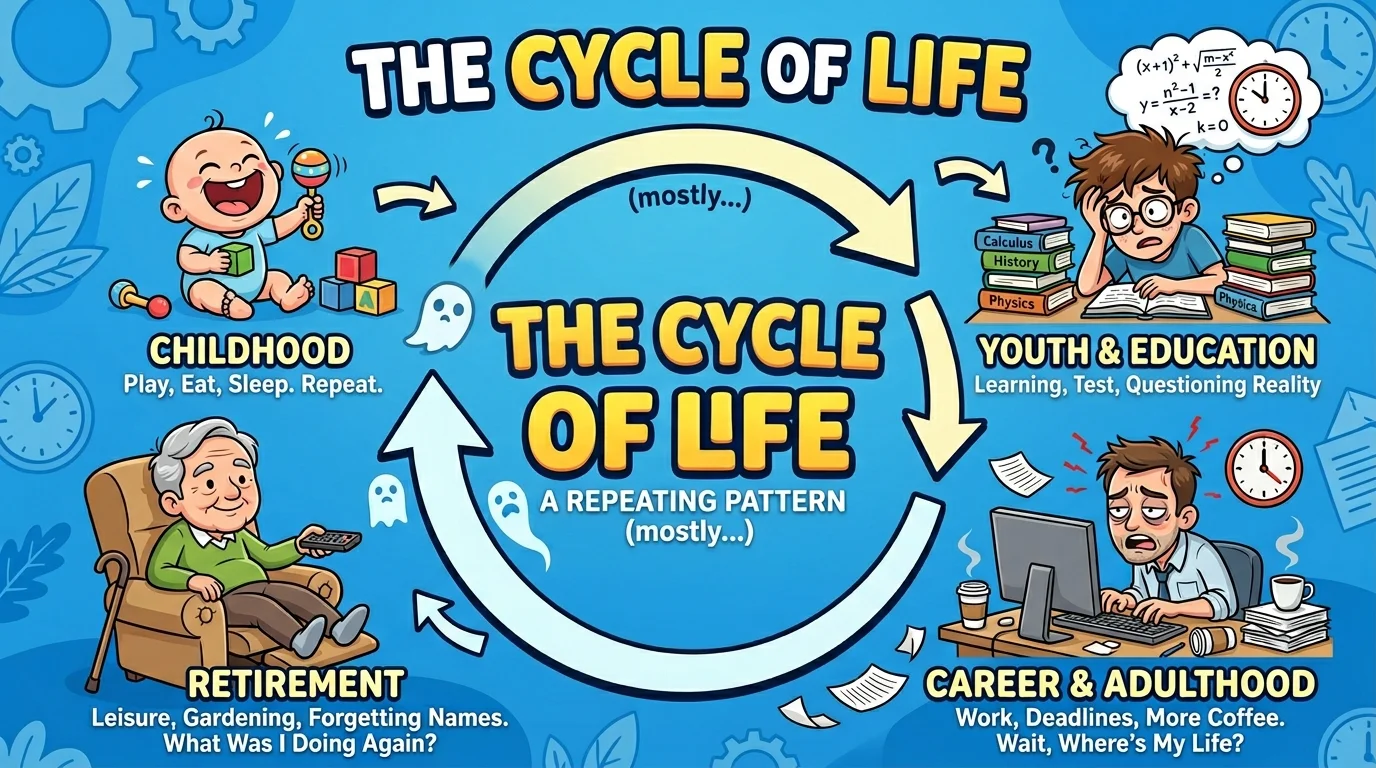
A cycle is a sequence of events, stages, or actions that repeats regularly and eventually returns to its starting point.
Simple Definition
Cycle = A repeating series of events or stages.
The key idea behind a cycle is repetition. After completing one round, the process begins again.
Different Meanings of Cycle
The word cycle can have several meanings depending on the context.
1. A Repeating Process
This is the most common meaning.
Example:
“The water cycle repeats continuously in nature.”
2. A Bicycle
In some countries, especially in British English, “cycle” is another word for a bicycle.
Example:
“He rides his cycle to school every day.”
3. A Period of Time
Cycle can describe a recurring period or pattern.
Example:
“The business cycle affects economic growth.”
4. A Natural Biological Process
Many biological functions occur in cycles.
Example:
“The menstrual cycle typically repeats each month.”
Origin of the Word Cycle
The word cycle comes from the Greek word kyklos, meaning “circle” or “wheel.”
It later entered Latin and French before becoming part of the English language.
Because a circle returns to its starting point, the concept became associated with repeating patterns and recurring events.
How People Use “Cycle” in Real Conversations
The word cycle is used in everyday conversations, education, science, business, health, and transportation.
Common Situations
People often say:
- “History tends to repeat itself in cycles.”
- “The economy is entering a new cycle.”
- “I bought a new cycle last week.”
- “Plants go through a life cycle.”
- “The project follows a development cycle.”
Why Context Matters
The exact meaning depends on the topic being discussed.
For example:
- In transportation, cycle often means bicycle.
- In biology, it refers to recurring natural processes.
- In business, it describes repeating economic patterns.
Real-Life Examples of Cycle
Example 1: Bicycle
Friend 1: How do you get to work?
Friend 2: I usually ride my cycle.
Meaning: The person uses a bicycle for transportation.
Example 2: Nature
“The water cycle helps distribute water around the Earth.”
Meaning: Water continuously evaporates, condenses, and falls as precipitation.
Example 3: Business
“The company is preparing for the next growth cycle.”
Meaning: A new period of business development is beginning.
Example 4: Education
“Butterflies go through a fascinating life cycle.”
Meaning: Butterflies pass through several stages from egg to adult.
Example 5: Daily Habits
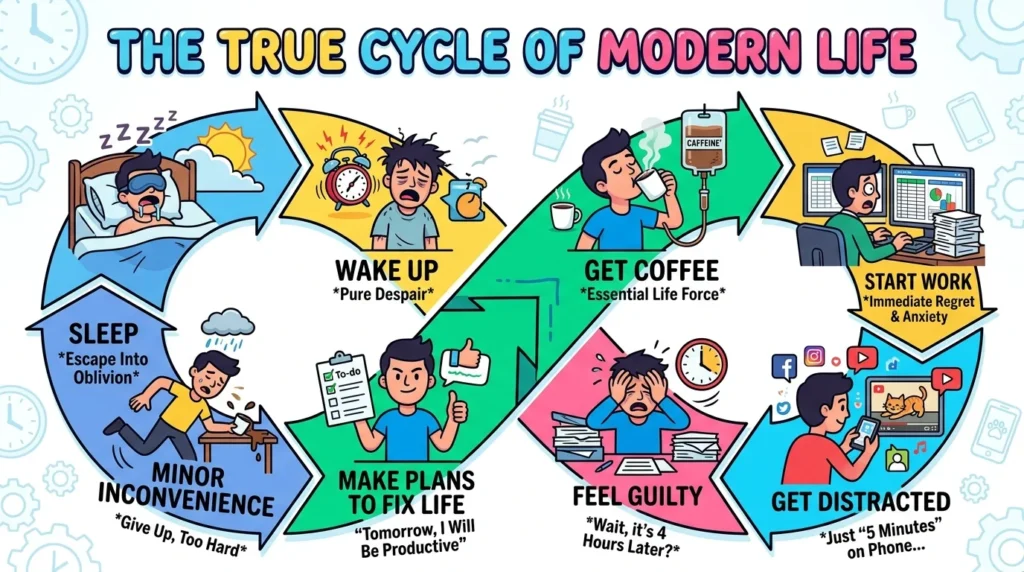
“I keep falling into the same cycle of procrastination.”
Meaning: The person repeatedly follows the same behavior pattern.

Common Types of Cycles
1. Water Cycle
A natural process involving:
- Evaporation
- Condensation
- Precipitation
- Collection
The process repeats continuously.
2. Life Cycle
The stages an organism experiences during its life.
Examples:
- Butterfly life cycle
- Frog life cycle
- Plant life cycle
3. Menstrual Cycle
A monthly biological process that prepares the body for possible pregnancy.
4. Economic Cycle
The recurring phases of economic activity.
These often include:
- Expansion
- Peak
- Contraction
- Recovery
5. Sleep Cycle
The repeating stages of sleep that occur throughout the night.
6. Product Life Cycle
Businesses use this concept to describe a product’s journey from launch to decline.
Common Mistakes & Misunderstandings
Many people misunderstand the word cycle.
1. Thinking It Only Means Bicycle
While cycle can mean bicycle, it more commonly refers to a repeating process.
2. Confusing Cycle with Circle
A circle is a shape.
A cycle is a repeating sequence or process.
3. Assuming All Cycles Are Natural
Many cycles are human-created.
Examples include:
- Business cycles
- Production cycles
- Marketing cycles
4. Believing Cycles Always Repeat Exactly
Some cycles repeat with variations and changes over time.
5. Ignoring Context
The meaning changes depending on the subject being discussed.
Synonyms of Cycle
Depending on context, common synonyms include:
- Sequence
- Pattern
- Series
- Rotation
- Round
- Loop
- Progression
- Recurrence
- Repetition
- Circuit
Example
“The cycle repeated.”
Can also mean:
“The pattern repeated.”
Antonyms of Cycle
The opposite may include:
- End
- Conclusion
- Stoppage
- Termination
- Break
- Interruption
Example
A cycle continues.
A termination stops.
Related Terms
If you’re learning the meaning of cycle, you may also encounter:
1. Repetition
Doing something again and again.
2. Loop
A sequence that returns to its beginning.
3. Rotation
Movement around a central point.
4. Period
A specific interval of time.
5. Recurrence
Something happening repeatedly.
6. Pattern
A repeated arrangement or behavior.
7. Bicycle
A two-wheeled vehicle often called a cycle.

Why Understanding Cycle Matters
The concept of cycles helps us understand:
- Nature
- Weather systems
- Human behavior
- Economics
- Health processes
- Business trends
- Scientific phenomena
Recognizing cycles allows people to predict changes, plan ahead, and understand how systems function over time.