
What Does “DOE” Mean in Salary or Job Listings?
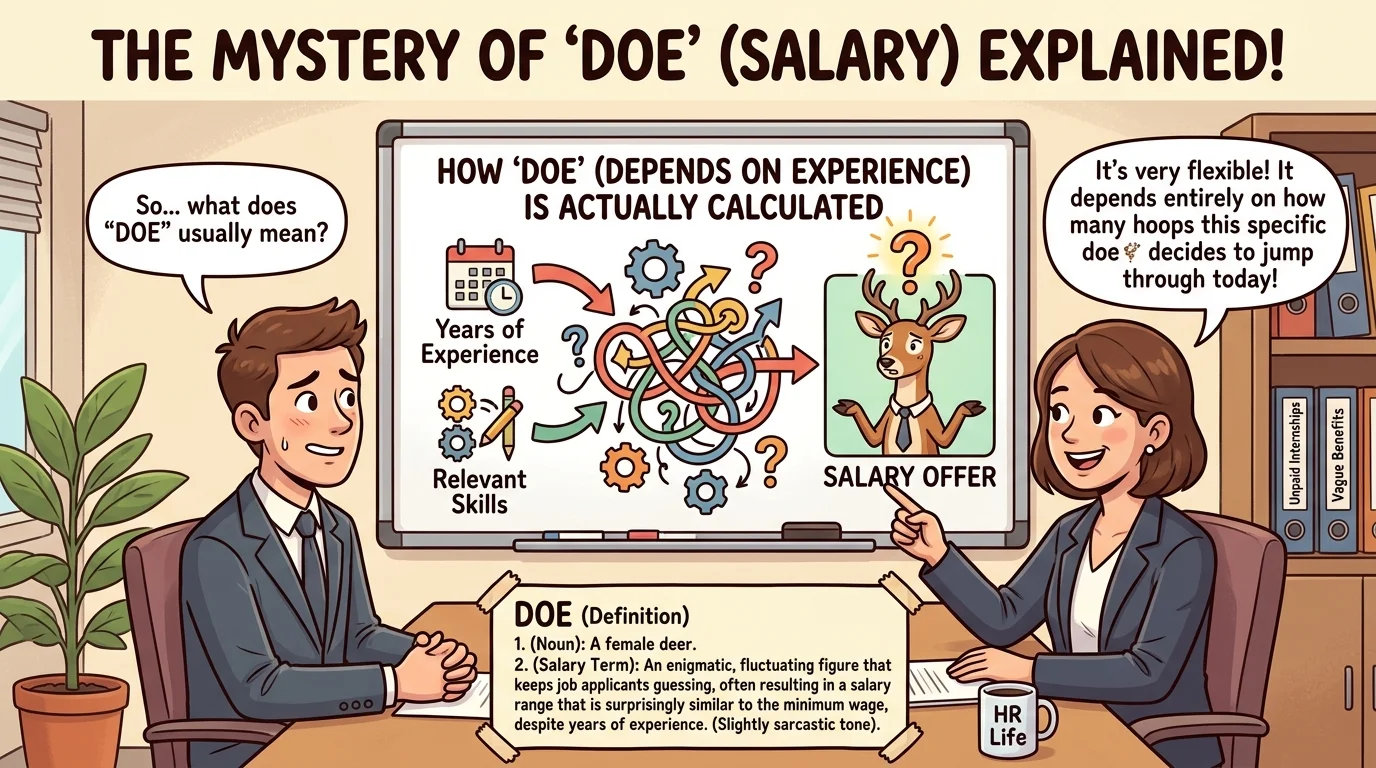
In employment and compensation discussions, DOE stands for “Depending on Experience.”
When a company lists a salary as DOE, it means there is no fixed pay amount. Instead, the employer determines the salary based on factors such as:
- Years of experience
- Industry knowledge
- Education and certifications
- Technical skills
- Previous job performance
- Specialized expertise
For example:
- Administrative Assistant – Salary DOE
- Marketing Manager – Compensation DOE
- Software Developer – Pay DOE
In each case, the company is signaling that the salary may differ from one applicant to another.
Different Meanings Based on Context
While DOE usually means Depending on Experience in job advertisements, the abbreviation can have other meanings in different industries.
Examples include:
- Department of Energy (government context)
- Design of Experiments (engineering and research)
- Depending on Experience (employment context)
When discussing salaries, compensation, or job postings, the intended meaning is almost always Depending on Experience.
Brief History of DOE in Hiring
The term has been used in recruitment for decades. Employers adopted DOE as a quick way to indicate flexible compensation structures without publishing a specific salary figure.
Today, DOE remains common in:
- Online job boards
- Company career pages
- Recruitment advertisements
- Staffing agency listings
- Internal hiring announcements
doe meaning How People Use “DOE” in Real Conversations
The phrase DOE frequently appears during job searches and salary negotiations.
Common Places You’ll See DOE
Job Listings
Employers often use DOE when advertising open positions.
Example:
“Customer Service Representative – Salary DOE”
This means pay will depend on the applicant’s experience level.
Recruitment Emails
Recruiters may mention DOE when discussing compensation.
Example:
“The salary range is DOE and will be discussed during the interview process.”
Interviews
Hiring managers often use the term when explaining compensation.
Example:
“We’re offering a competitive salary DOE.”
This means experienced candidates may qualify for higher pay.
Professional Networking Platforms
On sites like LinkedIn and career forums, professionals frequently ask about DOE salaries when evaluating opportunities.
When DOE Is Appropriate
DOE is commonly used when:
- Hiring for positions requiring different experience levels
- Recruiting specialized professionals
- Filling leadership roles
- Offering flexible compensation packages
When It Can Feel Frustrating
Many job seekers dislike DOE listings because:
- The exact salary isn’t clear
- Budget expectations remain uncertain
- Comparing opportunities becomes harder
That’s why candidates often ask for salary ranges early in the hiring process.
doe meaning Real-Life Examples of DOE in Text Messages
Here are some realistic examples showing how DOE is used in salary conversations.
Example 1: Job Search
Alex: I found a marketing job today.
Sarah: What’s the salary?
Alex: The listing just says DOE.
Explanation: The employer will determine pay based on the candidate’s experience.
Example 2: Recruiter Conversation
Recruiter: The compensation is DOE.
Candidate: Can you provide an estimated range?
Explanation: The candidate is requesting additional salary information.
Example 3: Interview Discussion
Hiring Manager: The role pays DOE.
Applicant: I have six years of industry experience. How would that affect compensation?
Explanation: Experience may influence the final salary offer.
Example 4: Career Forum Discussion
User 1: What does DOE mean in salary?
User 2: It means Depending on Experience. More experience usually leads to higher pay.
Explanation: This is the most common interpretation in hiring discussions.
Example 5: Internal Recommendation
Employee: My company is hiring.
Friend: What’s the pay?
Employee: It’s DOE, so it depends on your background and qualifications.
Explanation: Compensation varies between applicants.

How DOE Salaries Are Determined
When employers use DOE, they typically evaluate several factors before deciding on a salary offer.
1. Relevant Work Experience
Experience often has the biggest impact.
For example:
- Entry-level candidate: Lower salary range
- Mid-level candidate: Moderate salary range
- Senior candidate: Higher salary range
2. Specialized Skills
Candidates with in-demand skills may receive higher compensation.
Examples include:
- Programming languages
- Project management certifications
- Industry-specific expertise
- Technical licenses
3. Education
Higher educational qualifications can sometimes influence pay.
Examples:
- Bachelor’s degree
- Master’s degree
- Professional certifications
- Industry credentials
4. Market Demand
Some industries pay more because qualified professionals are difficult to find.
5. Location
Salary offers may also depend on:
- Cost of living
- Regional market rates
- Local labor demand
Common Mistakes & Misunderstandings
Many people misunderstand the meaning of DOE in salary discussions.
Mistake 1: Assuming DOE Means a Low Salary
Not necessarily.
Some employers use DOE because they are willing to pay significantly more for highly qualified candidates.
Mistake 2: Thinking Everyone Gets the Same Pay
The whole purpose of DOE is flexibility.
Two candidates applying for the same role may receive different salary offers.
Mistake 3: Ignoring Salary Negotiation
Many job seekers assume the employer’s first offer is final.
In reality, DOE often creates room for negotiation.
Mistake 4: Confusing DOE With Other Acronyms
Some people mistakenly think DOE refers to:
- Department of Energy
- Design of Experiments
- Other industry-specific terms
In compensation discussions, DOE almost always means Depending on Experience.
Mistake 5: Not Asking for a Salary Range
A DOE listing doesn’t mean you can’t ask questions.
You can politely ask:
- What is the expected salary range?
- How is compensation determined?
- What factors influence pay?
Related Slangs & Abbreviations
If you’re researching job listings, you’ll often encounter other hiring abbreviations alongside DOE.
D.O.Q. – Depending on Qualifications
Pay depends on both experience and qualifications.
EOE – Equal Opportunity Employer
Indicates the company follows equal employment opportunity practices.
FTE – Full-Time Employee
Refers to a full-time position.
PT – Part-Time
Indicates reduced working hours compared to full-time employment.
WFH – Work From Home
The employee works remotely.
CTC – Cost to Company
A term commonly used to describe total compensation packages.
These abbreviations frequently appear in recruitment ads and employment contracts.
Tips for Negotiating a DOE Salary
If you’re applying for a DOE position, consider these strategies:
- Research industry salary ranges.
- Know your market value.
- Highlight relevant achievements.
- Document certifications and skills.
- Ask for a compensation range early.
- Consider benefits in addition to salary.
- Be prepared to justify your expectations.
A DOE salary can actually benefit candidates who bring strong experience and specialized expertise.