


What Does “Fraction” Mean?
A fraction is a number that represents part of a whole or part of a group.
Fractions are typically written in the form:
Numerator / Denominator
For example:
- 1/2
- 3/4
- 5/8
- 7/10
In a fraction:
- The top number is called the numerator.
- The bottom number is called the denominator.
Here’s a visual representation of the basic fraction structure:
\frac{a}{b}
The denominator tells you how many equal parts the whole is divided into, while the numerator tells you how many of those parts are being counted.
Example
Consider:
\frac{1}{2}
This means:
- The whole is divided into 2 equal parts.
- You are talking about 1 of those parts.
In everyday language, 1/2 is often called one-half.
Origin of the Word Fraction
The word fraction comes from the Latin word fractio, which means “a breaking” or “a part broken off.”
This origin reflects exactly what fractions represent: a piece or portion of something larger.
fraction meaning How People Use Fractions in Real Life
Fractions aren’t limited to classrooms. They appear in many everyday situations.
Cooking and Baking
Recipes often use fractions to measure ingredients.
Examples:
- 1/2 cup of milk
- 3/4 teaspoon of salt
- 1/4 cup of sugar
Without fractions, following many recipes would be difficult.
Shopping and Discounts
Stores frequently advertise discounts using percentages, which are closely related to fractions.
For example:
- 50% off = 1/2 off
- 25% off = 1/4 off
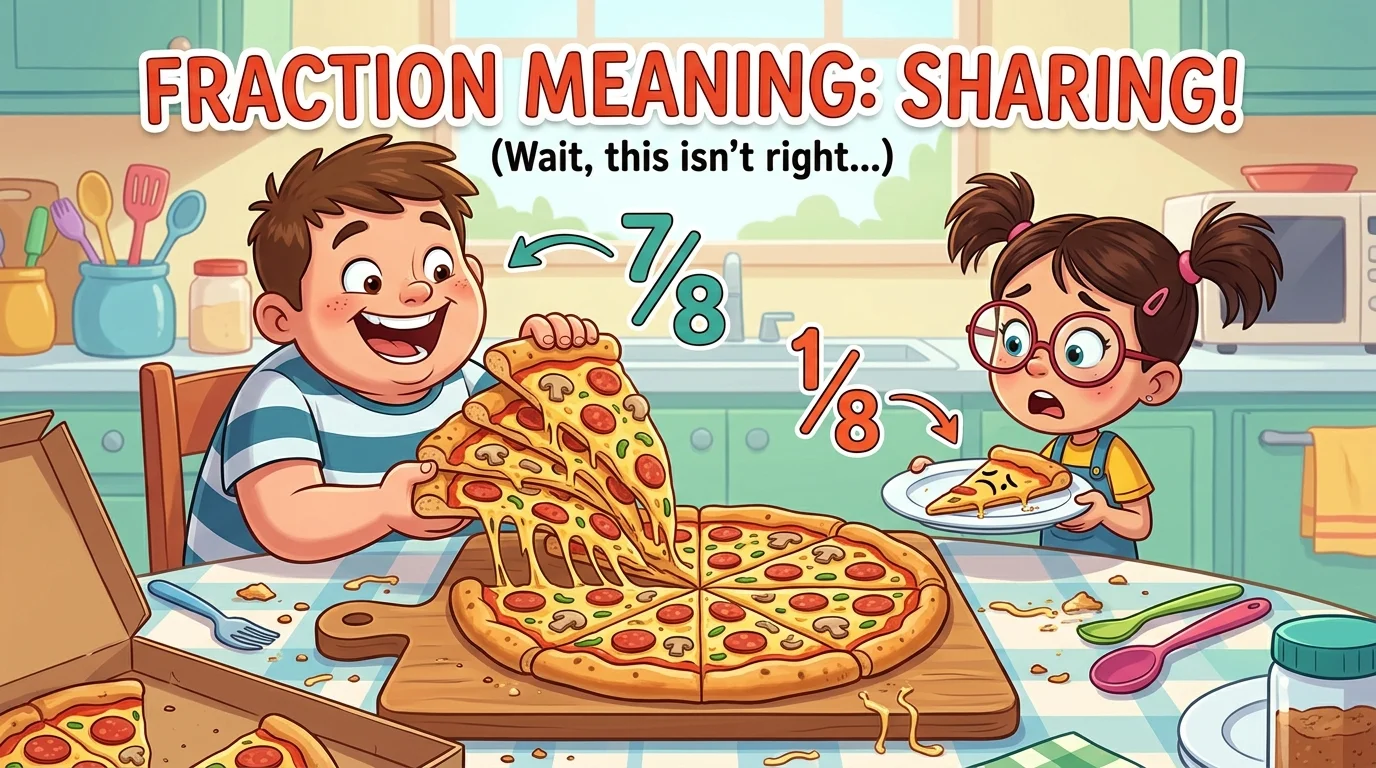
Sharing Food
Imagine a pizza cut into 8 slices.
If you eat 2 slices, you’ve eaten:
\frac{2}{8}
which can also be simplified to:
\frac{1}{4}
Construction and Measurements
Builders, carpenters, and engineers regularly use fractional measurements such as:
- 1/2 inch
- 3/8 inch
- 5/16 inch
Time
Fractions help describe portions of time.
Examples:
- Half an hour = 1/2 hour
- Quarter hour = 1/4 hour
fraction meaning Real-Life Examples of Fractions
Let’s look at some practical examples.
Example 1: Pizza Slices
A pizza has 8 slices.
You eat 4 slices.
The fraction is:
\frac{4}{8}
This simplifies to:
\frac{1}{2}
Explanation: You ate half the pizza.
Example 2: Students in a Class
A class has 20 students.
10 students are girls.
The fraction representing girls is:
\frac{10}{20}
which simplifies to:
\frac{1}{2}
Example 3: Chocolate Bar
A chocolate bar is divided into 12 pieces.
You eat 3 pieces.
The fraction eaten is:
\frac{3}{12}
which simplifies to:
\frac{1}{4}
Example 4: Water Bottle
You drink half of a water bottle.
This can be represented as:
\frac{1}{2}
Example 5: Test Score
You answer 18 out of 20 questions correctly.
Your score as a fraction is:
\frac{18}{20}
Types of Fractions
Proper Fractions
A proper fraction has a numerator smaller than the denominator.
Examples:
- 1/2
- 3/5
- 4/7
Improper Fractions
An improper fraction has a numerator equal to or greater than the denominator.
Examples:
- 5/4
- 8/3
- 9/9
Mixed Fractions
A mixed fraction combines a whole number and a fraction.
Example:
- 2 1/2
- 4 3/4
Equivalent Fractions
Different fractions can represent the same value.
For example:
\frac{1}{2}=\frac{2}{4}=\frac{4}{8}
All of these represent one-half.
Common Mistakes & Misunderstandings
Fractions can be confusing at first. Here are some common mistakes.
Confusing Numerator and Denominator
Many beginners mix up the two numbers.
Remember:
- Numerator = top number
- Denominator = bottom number
Thinking Bigger Denominators Mean Bigger Fractions
Consider:
\frac{1}{2}
and
\frac{1}{8}
Although 8 is larger than 2, 1/8 is actually smaller than 1/2.
Forgetting to Simplify
For example:
\frac{6}{12}
can be simplified to:
\frac{1}{2}
Assuming Fractions Are Only for Math Class
Fractions are used daily in:
- Cooking
- Shopping
- Construction
- Finance
- Sports statistics
- Time management

Related Mathematical Terms
Decimal
A decimal is another way to represent fractions.
Example:
\frac{1}{2}=0.5
Percentage
Percentages are fractions out of 100.
Example:
\frac{50}{100}=50%
Ratio
A ratio compares two quantities.
Example:
- 2:3
Whole Number
Whole numbers have no fractional parts.
Examples:
- 1
- 5
- 100
Division
Fractions and division are closely connected.
For example:
\frac{1}{2}=1\div2