
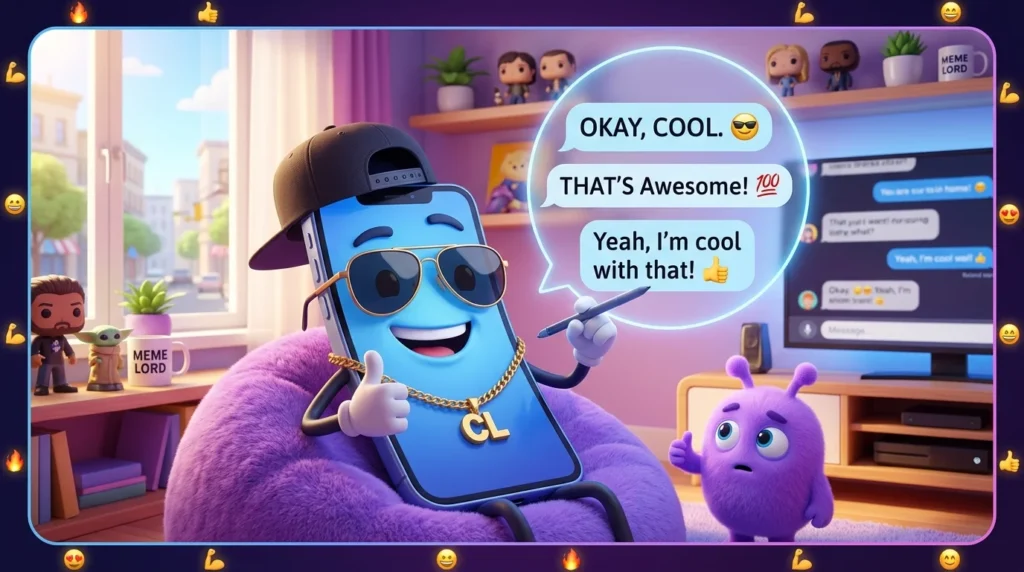
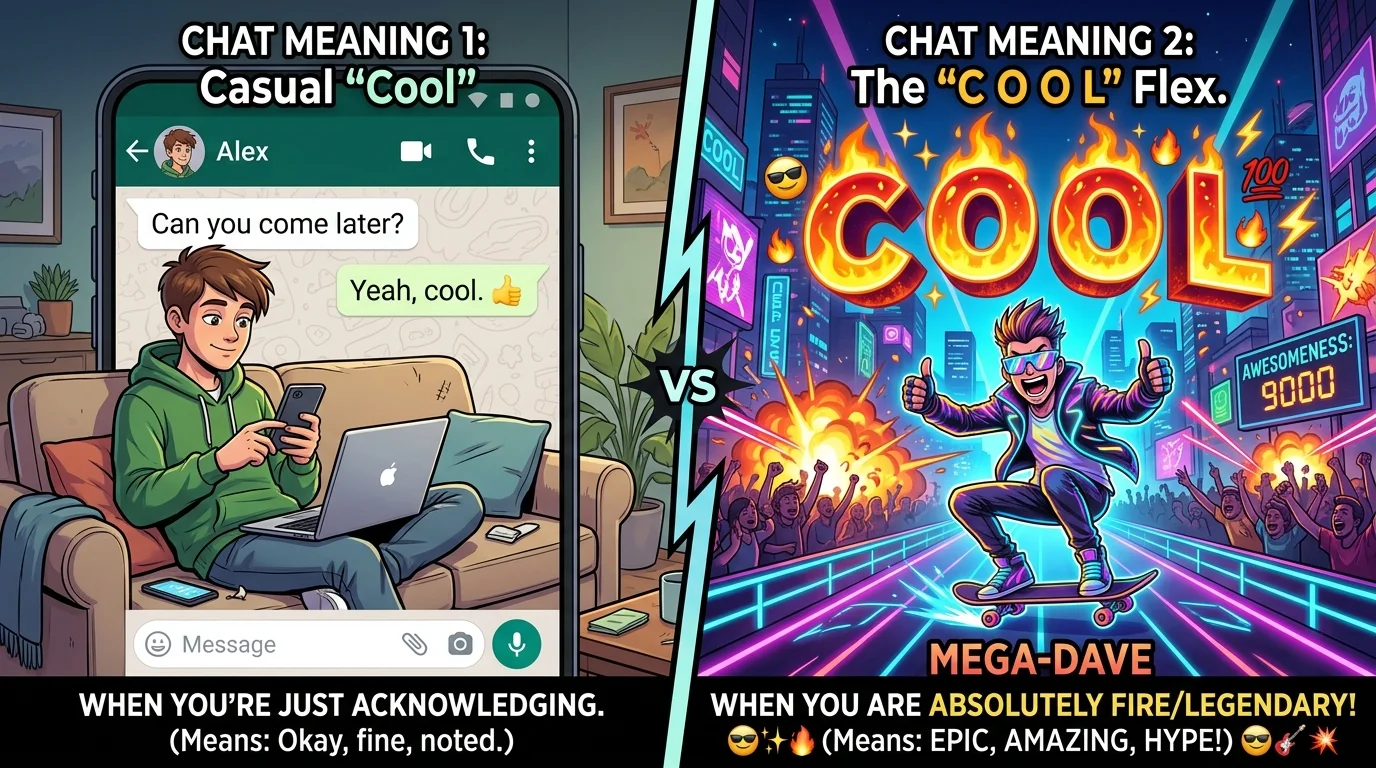
What Does “Cool” Mean in Chat or Text?
In chat and texting culture, “cool” usually means something is good, acceptable, interesting, impressive, or okay. It’s one of the most common casual responses online.
People use “cool” to:
- Show agreement
- Approve an idea
- React casually
- Sound relaxed
- End conversations politely
- Express excitement in a low-key way
Basic Definition of “Cool” in Text
Here are the most common meanings:
| Usage | Meaning |
|---|---|
| “Cool!” | Sounds excited or positive |
| “cool” | Neutral acknowledgment |
| “Cool cool” | Casual agreement |
| “That’s cool” | Approval or acceptance |
| “Cool…” | Sometimes awkward or annoyed |
So if someone texts “cool,” they’re usually saying:
- “Sounds good”
- “Okay”
- “Nice”
- “I understand”
- “I’m fine with that”
The History of “Cool” as Slang
The word “cool” has been slang for decades. It became popular in American jazz culture during the 1940s and later spread into mainstream English.
Over time, “cool” evolved from meaning “stylish” or “impressive” to becoming a universal internet response.
Today, it’s one of the most flexible words in online communication.
What Does “Cool” Mean in Text Specifically?
When people search for “what does cool mean in text”, they usually want to know whether the sender is:
- happy,
- annoyed,
- interested,
- or just being casual.
The answer depends heavily on tone.
For example:
- “Cool!!” = enthusiastic
- “cool” = relaxed acknowledgment
- “K cool” = short but friendly
- “Cool.” = can sound cold or distant
That tiny punctuation difference matters a lot in texting culture.
cool meaning in How People Use “Cool” in Real Conversations
The cool meaning in chat changes depending on where and how it’s used.
Texting Friends
Friends often use “cool” casually because it feels easy and natural.
Example:
“We’re meeting at 7.”
“Cool, see you then.”
In this situation, “cool” simply means “okay.”
Instagram & Snapchat
On social media, “cool” is often used as a reaction to:
- photos,
- stories,
- outfits,
- achievements,
- or plans.
Example:
“I got VIP tickets!”
“Cool!”
Here it means “that’s awesome.”
Discord & Gaming Chats
Gamers use “cool” constantly during teamwork or casual conversations.
Example:
“I’ll defend the base.”
“Cool, I’ll push mid.”
This version means agreement and coordination.
Dating Apps
This is where things get tricky.
On dating apps, “cool” can sometimes sound uninterested if the conversation already feels dry.
Example:
“I love traveling.”
“Cool.”
That response may feel low-effort or emotionally flat.
But:
“Cool! What’s your favorite place so far?”
sounds much warmer and engaged.
When “Cool” Sounds Positive
“Cool” usually feels friendly when paired with:
- exclamation marks,
- emojis,
- follow-up questions,
- or energetic wording.
Example:
- “Cool haha”
- “Cool!!”
- “That’s really cool”
- “Cool, tell me more”
When “Cool” Sounds Awkward
Sometimes “cool” becomes awkward because it ends the conversation too abruptly.
Example:
“I think we should stop talking.”
“Cool.”
That version can sound passive-aggressive or emotionally distant.
Tone is everything in online communication.
cool meaning in Real-Life Examples of “Cool” in Text Messages
Here are realistic examples showing different meanings of “cool” in chat.
Example 1: Friendly Agreement
Person 1:
“Movie starts at 8.”
Person 2:
“Cool, I’ll be there.”
Meaning:
Simple agreement and acknowledgment.
Example 2: Excitement
Person 1:
“I got the job!”
Person 2:
“Cool!! Congrats!”
Meaning:
Genuine excitement and happiness.
Example 3: Casual Conversation
Person 1:
“I’m learning Japanese.”
Person 2:
“Oh cool.”
Meaning:
Interest mixed with casual friendliness.
Example 4: Dry Reply
Person 1:
“I can’t come tonight.”
Person 2:
“Cool.”
Meaning:
Could sound disappointed, annoyed, or emotionally distant.
Example 5: Gaming Chat
Player 1:
“I found extra ammo.”
Player 2:
“Cool, bring it here.”
Meaning:
Quick teamwork acknowledgment.
Example 6: Sarcastic Usage
Person 1:
“My internet died during the final match.”
Person 2:
“Cool. Love that for you.”
Meaning:
Clearly sarcastic.

Common Mistakes & Misunderstandings
Even though “cool” seems simple, people misunderstand it all the time.
1. Thinking “Cool” Is Always Positive
Not always.
A plain “cool.” with a period can sometimes feel cold or dismissive.
Text tone changes meaning dramatically.
2. Overusing It in Conversations
If every reply is “cool,” people may think you’re:
- bored,
- uninterested,
- distracted,
- or trying to end the chat.
Variety matters in conversations.
3. Misreading Dry Texting Style
Some people naturally text very short replies.
So “cool” may not mean they’re upset at all.
That’s why context matters more than the word itself.
4. Confusing Real Enthusiasm with Neutral Replies
Compare these:
- “Cool!!!”
- “cool”
- “Cool.”
Each gives a completely different emotional vibe.
5. Using It in Serious Conversations
“Cool” can sound insensitive during emotional topics.
Example:
“My dog passed away.”
“Cool.”
That would feel extremely inappropriate.
Always match the emotional tone of the conversation.
cool meaning in Related Slangs & Abbreviations
If you’re learning the cool meaning slang, these related terms are also common online.
Nice
Means something is pleasant, good, or impressive.
Example:
“Nice pic!”
Bet
Popular Gen Z slang meaning:
- “okay,”
- “sure,”
- or “sounds good.”
Example:
“Meet at 6?”
“Bet.”
Lit
Means exciting, fun, or amazing.
Example:
“That concert was lit.”
Dope
Means something is extremely cool or impressive.
Example:
“Those shoes are dope.”
Fire
Used when something is excellent or visually impressive.
Example:
“That song is fire.”
Sick
Often means something is extremely cool.
Example:
“That trick was sick.”
Chill
Means relaxed, calm, or easygoing.
Example:
“He’s really chill.”
OK / K
Short acknowledgment responses similar to “cool,” but sometimes colder in tone.

Why “Cool” Still Matters in Internet Culture
Even in 2025, “cool” remains one of the most widely used internet slang words because it’s:
- simple,
- flexible,
- universal,
- and emotionally adaptable.
People use it across:
- texting,
- gaming,
- TikTok comments,
- Instagram DMs,
- Discord servers,
- and workplace chats.
Its meaning changes naturally based on tone, punctuation, and context.