

What Does Decimal Mean?
Decimal is a noun and an adjective that relates to numbers based on the number 10.
Key Definitions
As a Noun:
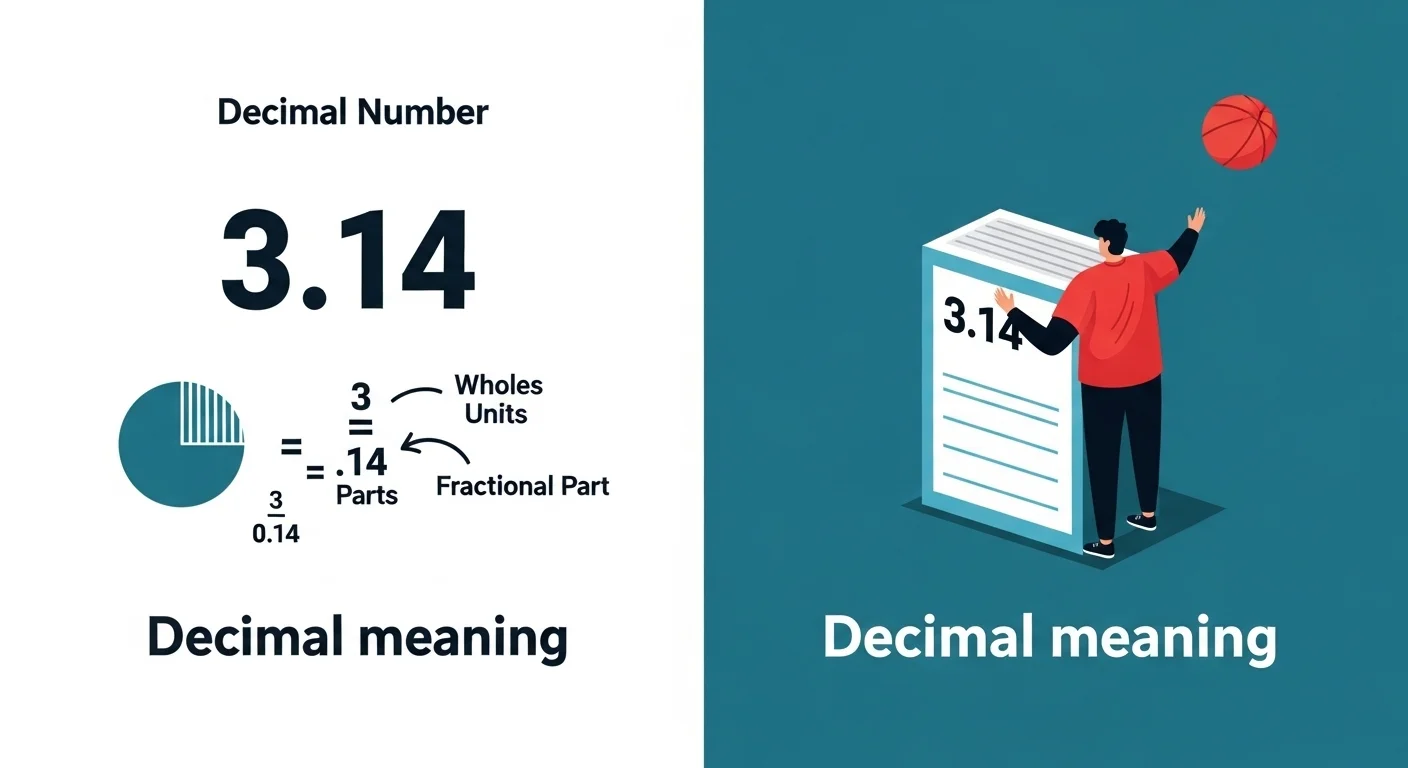
A number expressed in the base-10 system, especially numbers with a point separating whole numbers from fractional parts.
Example:
3.14 is a decimal number.
0.75 is a decimal representing 75 hundredths.
As an Adjective:
Relating to a system of numbers based on ten, or a decimal point.
Example:
“We use the decimal system for everyday calculations.”
“Round the number to two decimal places.”
Origin of the Word
Comes from the Latin word “decimus”, meaning “tenth”.
Introduced to represent numbers as parts of ten, forming the decimal system.
The concept of decimal fractions has been around since ancient civilizations but became standard in Europe around the 16th century.
How Decimals Are Used in Real Life
1. Mathematics
Decimals are essential in math for representing fractions, measurements, and percentages.
Example:
0.5 = 1/2
0.25 = 1/4
Decimals make calculations easier, especially when working with money, weights, or scientific data.
2. Money and Finance
Decimals are used to represent cents in dollars or other currencies.
Example:
$10.75 means 10 dollars and 75 cents.
Stock prices, interest rates, and tax calculations all use decimals.
3. Measurements
Decimals are used in length, weight, and volume.
Example:
2.5 meters
0.75 liters
3.14 kilograms
4. Everyday Usage
Decimals are common in recipes, shopping, and sports statistics.
They help represent precise quantities, rather than rounding to whole numbers.
Example:
“The cake needs 1.25 cups of sugar.”
“He ran 4.8 kilometers.”
Real-Life Examples of Decimal
Math Example
“Convert 3/4 into a decimal: 3 ÷ 4 = 0.75.”
Money Example
“The total bill is $23.45.”
Measurement Example
“The board is 2.7 meters long.”
Percentage Example
“A 12.5% discount can also be written as 0.125 in decimal form.”
Common Mistakes & Misunderstandings
Decimal ≠ Whole Number
A decimal can include whole numbers, but it often represents fractional parts.
Decimal Point Confusion
Always remember the dot separates the whole number from the fractional part.
Decimal Place vs. Decimal Number
Decimal place = position after the decimal point (tenths, hundredths, thousandths).
Decimal number = any number that uses a decimal point.
Related Terms & Concepts
Decimal system (base-10): The number system we use daily, based on 10 digits (0–9).
Decimal point: The dot separating whole numbers from fractions.
Decimal fraction: A fraction written with a denominator of 10, 100, 1000, etc.
Percentages: Often converted to decimals (e.g., 25% = 0.25).
Place value: Tenths, hundredths, thousandths, etc., after the decimal point.